FRC National Audit and Assurance Firms Register: What It Means
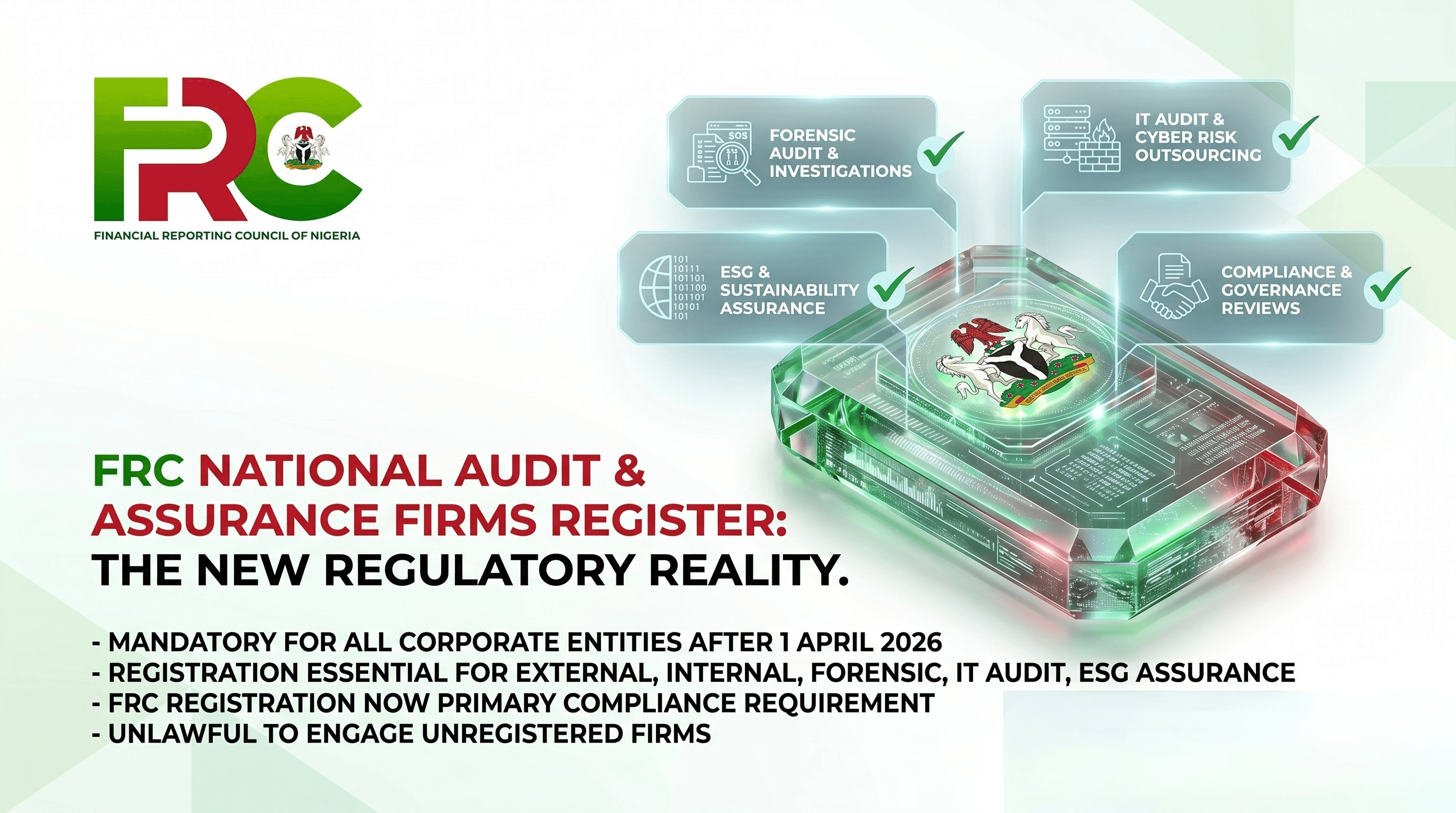
New Regulatory Milestone: FRC Publishes National Audit Register
Strengthening corporate governance and assurance oversight in Nigeria
What the FRC is and why this register exists?
The Financial Reporting Council (FRC) of Nigeria is the statutory regulator responsible for financial reporting standards, corporate governance and assurance oversight in Nigeria. Under the FRC Act 2011 (as amended) and the Audit Regulations 2020, the FRC has authority to register audit firms and assurance providers, set standards for audit practice and sanction non-compliance.
The FRC has announced it will publish the National Audit and Assurance Firms Register, which is a central list of firms approved by the FRC to provide statutory audit services and other assurance services. This enforcement was announced through a regulatory publication issued on 9 February 2026, pursuant to Sections 33, 51, 60, 61, and 77 of the Financial Reporting Council of Nigeria Act No. 6, 2011 (as amended) and the Audit Regulations 2020.
What the new enforcement means
From 1 April 2026, it will be unlawful for any corporate entity to engage an external auditor or engage any assurance service provider unless the firm is listed on the FRC National Register.
This means even if a firm is licensed by ICAN (The Institute of Chartered Accountants of Nigeria) or ANAN (The Association of National Accountants of Nigeria), it must also be registered with the FRC to provide assurance services.
Who counts as an “assurance service provider”?
The FRC's concept of assurance goes beyond statutory audit. It includes firms that provide:
So, the rule does not apply only to annual financial auditors.
Does it apply to CREDICORP?
This new rule applies to CREDICORP in terms of vendor-selection and compliance, but not in a registration. It applies if CREDICORP engages external auditors, internal audit consultants, risk or compliance assurance firms, forensic auditors.
After 1 April 2026, in such cases the firm must appear on the FRC register. Otherwise, the engagement would be unlawful and potentially voidable.
It does NOT apply in this way: CREDICORP itself is not required to register unless it begins offering assurance services to third parties.
Practical impact on organisations
From a governance perspective, this creates three operational obligations:
1. Vendor due diligence
It is necessary to conduct a due diligence before appointing any auditor, Internal audit consultant, risk or compliance reviewer, in order to verify that the firm is on the FRC register.
2. Procurement control
Procurement, Finance, Risk, and Legal must include FRC registration check as a mandatory step in the onboarding of assurance vendors.
3. Contractual safeguards
Engagement letters should now include a warranty that the firm is registered with the FRC in good regulatory standing.
Risks of non-compliance
The possible consequences for companies who do not comply with the new regulation are:
What is the purpose of this new rule by FRC
The register is meant to:
- Improve audit quality and assurance standards across Nigeria.
- Increase regulatory oversight and accountability for audit firms.
- Prevent unqualified or unregulated firms from performing critical assurance work.
- Align Nigeria with global audit oversight practices and best standards.
Scenario Analysis
Before April 2026
CREDICORP hires a consulting firm to perform an internal audit review.
- The firm is licensed by ICAN.
- No FRC register requirement enforced.
- Engagement proceeds normally.
After April 2026
CREDICORP hires the same firm.
If the firm is not on the FRC register:
- The engagement becomes unlawful.
- The audit report may not be recognized by regulators.
- CREDICORP may face regulatory queries and sanctions.